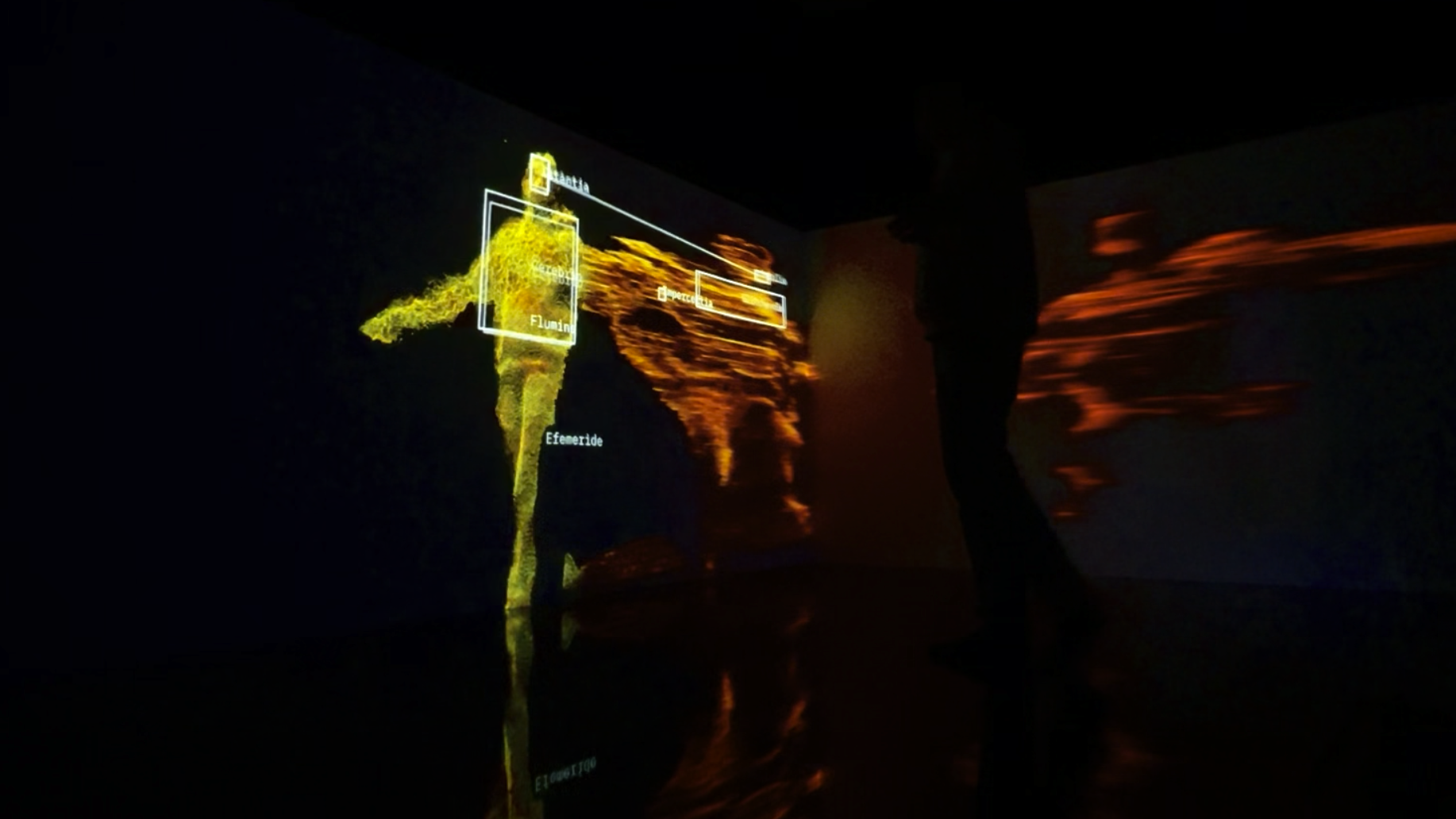
Automatic Impermanence is an immersive and interactive installation by Alex Braga, presented at Triennale di Milano for Milano Cortina 2026.
I was responsible for the full development of the video system and interactive behaviors of the work.
The installation unfolds as a poetic environment that reflects on fragility, transformation, and the constant state of becoming that defines contemporary existence. Bodies and presences are translated into fields of light and matter, dissolving and recomposing in continuous metamorphosis. The visitor’s image is fragmented into luminous particles, suspended between visibility and disappearance, creating a perceptual journey that oscillates between the tangible and the intangible. Impermanence becomes not only a theme but an experience—one that unfolds in real time through movement, sound, and light.
The work establishes a deep interconnection between the physical presence of the audience and the audiovisual space, where every gesture influences the evolving visual and sonic landscape. The installation exists as a living system, never repeating itself, constantly shaped by the interaction between human presence and computational processes.
Technical development
The installation was developed using a real-time audiovisual pipeline. Interactive visuals were created in TouchDesigner, driven by data captured through two Azure Kinect sensors tracking the movement and position of visitors in space. Sound design and musical structures were generated and processed live in Ableton Live, tightly synchronized with the visual system. All video and audio outputs were generated in real time, allowing the installation to remain responsive, dynamic, and continuously evolving throughout its duration.
Brain Rot
Short Project Introduction
Brain Rot is an audiovisual installation about social media overload by Nicola Carpeggiani and Alessandro Roberti (Studio Cliché), with sound design by CANYF.
Presented at Videocittà Expo 2025 (July 2025) and Moebius – La Rampa Prenestina (December 2025), the project explores cognitive saturation and the erosion of meaning caused by continuous exposure to fragmented digital content.
Through a real-time generative audiovisual system, Brain Rot constructs a destabilized media flow in which images, identities, and narratives dissolve into repetition and overstimulation, reflecting on the compulsive logic of contemporary digital feeds.
Technical Notes / Process
Concept & System
Brain Rot is a real-time generative installation reflecting on cognitive overload and the erosion of meaning caused by continuous exposure to fragmented media streams.
The project treats contemporary visual information as an unstable system in which images, identities, and narratives collapse into an indistinct flow, prioritizing stimulation over understanding.
Generative Logic
Social media footage is procedurally remixed in real time and visually glitched through non-linear transformations.
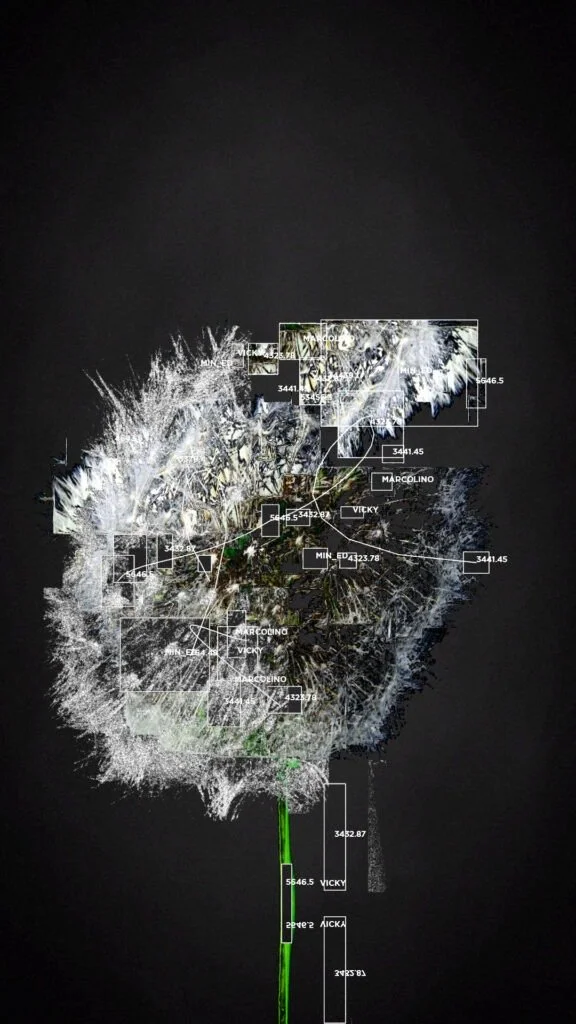
Faces are selectively removed using tracking and computer vision techniques (MediaPipe), preserving the action while erasing authorship and identity.
Additional object recognition processes generate unstable semantic labels that fragment and overload the visual narrative.
A simulated “fake reel” environment is generated within the system, composed of AI-generated imagery, algorithmic text, and live camera input.
Video content and textual elements are randomly assigned to each post; their combinations can be reconfigured through a seed-based system, enabling controlled variability and non-repetitive behaviors.
A live video feed captured via an Azure Kinect camera is embedded within the fake reel, placing the audience inside the artificial content stream and reinforcing the tension between real presence and constructed media narratives.
Visual & Spatial Output
The installation is distributed across a multi-screen setup composed of CRT televisions and vertically oriented LCD displays.
A central media server provides three independent outputs, each routed through dedicated video wall controllers and further subdivided into individual signals feeding the single displays.
This layered distribution system generates a fragmented and non-uniform visual field that mirrors the conceptual theme of information overload.
Pipeline & Control
TouchDesigner functions as the core real-time generative engine, managing video remixing, AI content integration, camera input, and system logic.
Computer vision processes based on MediaPipe are integrated within the pipeline for face removal and object recognition.
Visual output is routed into Resolume Arena for final playback, mapping, and distribution across the multi-screen setup.
Resolume Arena is controlled through a timeline-based structure driven by Ableton Live via MIDI messaging, with each visual event triggered by dedicated MIDI signals.
Ableton Live also hosts the sound design and functions as the main temporal and control layer of the system.
Audio–visual synchronization is handled via a dedicated audio interface and mixed digital-to-analog signal routing.
Tools
TouchDesigner · MediaPipe (computer vision & tracking) · Resolume Arena · Ableton Live · Adobe After Effects · AI image & text generation tools · Video wall controllers · CRT & LCD displays
Role
Concept development, system and spatial design, multi-screen mapping and layout, real-time generative visuals, interactive pipeline integration
This is an audiovisual performance created in collaboration between producer BIDISC and visual artist Nicola Carpeggiani, presented at Videocittà 2025.
The collaboration between the two artists began in 2024, with the aim of exploring new expressive languages through the synergy of sound and image. At the core of the project are audio-reactive visual production techniques: visuals are generated and manipulated in real time using TouchDesigner, dynamically responding to audio and MIDI streams produced by BIDISC.
The result is an immersive experience in which sound shapes visual matter, forming a continuous dialogue between electronic music and ever-evolving digital landscapes
On November 29, 2024, the immersive video mapping experience "Cosmogonia" transformed the Horti Sallustiani in Rome during the electronic music event Lisergica. Created by Field A1 in collaboration with visual artist Nicola Carpeggiani, the project blended cutting-edge technology with historical ambiance in this Roman archaeological site.
Field A1's expertise in digital art and 3D graphics paired seamlessly with Carpeggiani's real-time, music-reactive visuals, utilizing advanced software to synchronize imagery with live electronic performances. Artists such as Nabir (live coding) and Evorak (modular synthesis) further enriched the audio-visual landscape, delivering innovative and immersive performances
The unique setting of the Horti Sallustiani amplified the project's impact, merging contemporary multimedia art with the site's ancient grandeur. The installation exemplified the potential of modern technology to reimagine historical spaces, offering attendees a deeply emotional and visually stunning experience
The opening event of Forte! Trionfale in Rome on November 14, 2024, featured an extraordinary audiovisual performance designed by Nicola Carpeggiani and Studio Clichè. This site-specific show combined audioreactive video content with the electronic sounds of Frenetik & Orange, creating an immersive and responsive storytelling experience tailored to the unique setting of the historic Forte Trionfale.
Nicola Carpeggiani played a key role as the interaction designer, ensuring that the video visuals adapted dynamically to the music, transforming the space into a pulsating canvas of light, sound, and motion. The performance also featured laser effects by LaserShow, adding vibrant accents that highlighted the interplay between architecture and art.
This event brought together historical architecture and cutting-edge digital artistry, emphasizing the fusion of tradition and innovation.
For the closing night of the 2024 C2C Festival at OGR Torino, Nicola Carpeggiani curated and executed a visually stunning and immersive experience. With performances by Sofia Kourtesis, John Talabot, and Evilgiane, the event epitomized the festival's avant-garde ethos, uniting groundbreaking music with innovative visual storytelling.
Carpeggiani handled the entirety of the video design, crafting audioreactive visuals using TouchDesigner. These included generative geometric patterns and the seamless remixing of C2C’s branding elements with visuals originally created by Weirdcore, resulting in a layered and dynamic narrative. The visuals responded in real-time to the energy and soundscapes of the performers, transforming the OGR space into a pulsating, immersive environment.
The lighting design was masterfully operated by Edoardo Munari, while the striking stage design was conceptualized by Bobbi Studio, whose work complemented the visuals and music to create a cohesive, multisensory spectacle. Together, the team delivered an unforgettable closing event, highlighting Carpeggiani's expertise in blending technology, art, and live performance
For Goa Ultrabeat, we developed a series of teaser videos conceived as audiovisual fragments: autonomous episodes designed to resonate with the venue’s imaginary and intensify its atmosphere. The project unfolds as a system of images where natural elements and visual manipulation converge into a contemporary, hypnotic language—fluid, unstable, and in constant transformation.
Within Studio Clichè, I curated and built the motion tracking and sound-reactive animations using TouchDesigner. Sound acts as the primary driving force, triggering micro-variations, controlled glitches, and perceptual pulsations. Textures and organic forms are modulated in real time, progressively composing a loose narrative pattern made of apparitions, drifts, and returns.
Each composition behaves like a living organism: it breathes, shifts tempo, and allows itself to be traversed by audio and matter. Nothing is fixed—every visual state is the result of a continuous negotiation between sound input and generative structure.
The outcome is a custom visual grammar: reactive, impermanent, and never identical to itself. A system where sound initiates transformation and visual matter constantly mutates in response.
Concept & Direction: Alessandro Roberti
Motion Tracking & Sound-Reactive Animations (TouchDesigner): Nicola Carpeggiani / Studio Clichè
Music Curation: Costanza Facchini
Production: Margherita Toniolatti
For the performance "Gnole" I created the interactive and real-time video content, using TouchDesigner as the development platform. My goal was to craft a dynamic visual experience that would seamlessly integrate with the works of Alberonero, the all analog sounds produced by Frenetik & Orange and the environment designed by Varsi and Studio Cliché.
To achieve this, I incorporated a LIDAR sensors to capture the movements of the performer and other environmental variables, allowing the projections to react in real-time, creating a direct interaction between the visitors and the projections themselves.
The result was an immersive environment where the boundary between spectator and artwork dissolved, transforming the audience into active participants. The images and patterns generated with TouchDesigner responded to movements detected by the Kinect, adding a layer of sensory participation and amplifying the theme of the relationship between body and space.
Nicola Carpeggiani is a visual artist whose work explores the intersection of technology, sound, and perception. As a key collaborator in Alex Braga's performance "Automatic Impermanence" at the Mico in Milan, Carpeggiani was responsible for creating real-time, audio-reactive visuals. The performance, which featured Braga performing alongside an AI to compose live music, was brought to life through Carpeggiani’s dynamic visuals. Using intricate coding, points, and lines, he translated the music into visual representations, forming 3D meshes that corresponded to the themes and emotions of each piece. To deepen the immersive experience, a Kinect Azure scanner captured Braga's movements as he performed, integrating his live image into the 3D particle mesh space, adding a human element to the digital visuals. Carpeggiani's work uniquely bridges the gap between the physical and virtual worlds, offering audiences a multi-sensory experience that is both ephemeral and ever-evolving.
Automatic Impermanence by Alex Braga, showcased at Palazzo Cipolla during the exhibition Ipotesi Metaverso, is a cutting-edge multimedia installation blending technology and art to explore themes of impermanence and the human experience in a digital age. Developed in collaboration with visual artist Nicola Carpeggiani, who crafted the interactive video elements, the installation leverages advanced artificial intelligence and 3D scanning to transform participants' presence into dynamic, abstract art.
As visitors interact, the system captures their forms and movements, converting them into point clouds within a 3D space. These visual representations evolve in sync with Braga's music, creating a constantly shifting fusion of sound and visuals. Produced by Robert Lippok, the project examines the delicate interplay of human and machine, challenging viewers to reflect on the boundaries of technology and humanity, and to "find the infinite within the finite"
This innovative work underscores Braga's commitment to sustainable and decentralized approaches in art, aiming to promote mindfulness in a world increasingly shaped by digital and ecological concerns
Digital Vandalism is an interactive installation co-produced by visual artist nicosfkng and Roman Doors, showcased at the RGB Light Festival in Rome in 2022.
This innovative project reimagines urban graffiti within a digital medium, channeling the rebellious essence of street art through advanced projection mapping and real-time interactivity. Visitors are invited to "vandalize" a virtual canvas by performing physical gestures that are translated into dynamic, graffiti-inspired visuals.
During the performance, a database of tags and throw-ups was collected from various Roman writers, integrating their authentic street art styles into the project. These contributions form a constantly evolving pattern of text and imagery, a digital homage to the graffiti-covered vans commonly seen in the Roman neighborhood of Torpignattara. Inspired by this vibrant urban landscape, the installation captures the impermanent, collaborative spirit of graffiti while offering a new perspective on self-expression in the digital age.
By inviting participants to contribute their creations, Digital Vandalism explores themes of urban identity, ephemerality, and community collaboration. The installation bridges the gap between traditional street art and cutting-edge technology, allowing users to leave their mark in a space where art continuously mutates and reinvents itself, mirroring the dynamic energy of city life.
Roma Jazz Festival 2022: First Collectible NFT
For the 2022 edition of the Roma Jazz Festival, I collaborated with Studio Clichè and A-LIVE to create the festival’s first collectible NFT in celebration of its 46th anniversary. As the video creator, I combined Stable Diffusion with frame-by-frame animation to craft an original audiovisual piece that brings to life 46 iconic festival posters, set to Train Drive, a jazz composition by Lorenzo Mirra, Giacomo Serino, and Emanuele Guarnieri.
Through this blend of AI-generated visuals and meticulous frame-by-frame animation, I worked with Studio Clichè and A-LIVE to reinterpret jazz’s visual and cultural legacy in a vibrant digital form. The NFT captures the rhythm and improvisational spirit of jazz in an animated narrative, merging cutting-edge technology with the authentic essence of jazz.
This project is a fusion of technology, culture, and artistic storytelling—a digital jazz celebration that pushes creative boundaries and highlights the dynamic potential of AI and animation in modern art.
Nicola Carpeggiani contributed to Soundscape, an interactive installation created by Studio Cliché and showcased during the Maker Faire Rome - European Edition 2022 at the Gazometro Ostiense. The project, curated by Andrea Lai, featured immersive performances from artists such as NAIP, Samuel, and Frenetik & Orang3, blending sound, visuals, and technology in a 360-degree experience.
Carpeggiani's role focused on the creation of dynamic video content, utilizing motion graphics and cutting-edge techniques like image generation through Stable Diffusion. This process started with hand-drawn illustrations that were scanned and transformed into evolving visual narratives, harmonizing with the installation's immersive, multidimensional environment. Soundscape emphasized the fusion of sound and visuals, creating a living "organism" of lights, pixels, and audio that engaged audiences in a sensory dialogue
"Self on the Shelf", presented at the Spring Break Art Fair 2018 in New York, is an immersive and interactive installation created by Laia Cabrera, Isabelle Duverger, and Nicola Carpeggiani. This unique project blends storytelling with advanced technology to transform an ordinary child's bedroom into a dynamic, dreamlike environment.
Nicola Carpeggiani’s role as the interaction designer was pivotal in bringing the installation to life. He integrated interactive elements into the room, enabling visitors to physically engage with various objects that triggered changes in the immersive video projections. These tactile interactions altered the digital environment in real-time, allowing for a non-linear storytelling experience that adapted to each participant’s choices. By touching and manipulating the objects, viewers could uncover layers of narrative, shifting the room from serene dreamscapes to intense storms or fantastical realms.
The installation combined projection mapping and video design to envelop visitors in an evolving story, blending childlike wonder with deeper themes of identity and reflection. Carpeggiani’s expertise in interactive media ensured that the environment felt alive and responsive, turning visitors into co-creators of the experience.
"Self on the Shelf" exemplifies a harmonious fusion of interactivity and visual artistry, showcasing Carpeggiani's talent for designing engaging digital experiences that captivate audiences and challenge traditional storytelling methodsing